Transforming demand.
The power of prevention
The challenge
Local government is facing unprecedented demand and financial pressure. Prevention offers a transformative opportunity to reduce costs and improve outcomes – not just within specific services, but across the whole council. By tackling root causes, preventing crisis demand, and embedding targeted, strengths-based support, councils can create a more productive and resilient system. Everyone agrees that prevention is the right thing to do. The challenge is doing it in a way that builds confidence from chief executives to frontline staff. That means focusing on what works, tracking impact, and embedding a cultural shift across the system.
The IMPOWER offer
At IMPOWER, we believe in prevention as a strategic priority – not as an add-on, but as a core element of a purposeful council. Our prevention framework focuses on three critical pillars:
Strengths-based approaches
Empowering people and communities to build resilience and reduce dependency.
Integrated service design
Aligning support across services to address interconnected drivers of demand.
Measurable outcomes
Demonstrating financial and social impact through rigorous tracking of Return on Investment (ROI).
Insights from our work
Through review of 1,199 cases across adult social care, homelessness and children’s services in 28 different projects, local frontline teams have identified that on average, 49% of demand could have been avoided.
- Case reviews highlighted common drivers of avoidable demand, including mental health, substance misuse, domestic abuse, and family breakdown.
- Existing early help and preventative activity is often not targeted at the cohorts with the highest needs, nor effective at tackling complex root causes.
- Our real-world delivery experience tells us that while 49% avoidability is a helpful reference point, achieving it in full isn’t realistic due to complexity and the need for whole-system alignment. However, around half of that avoidable demand is typically achievable through focused, multi-layered change.
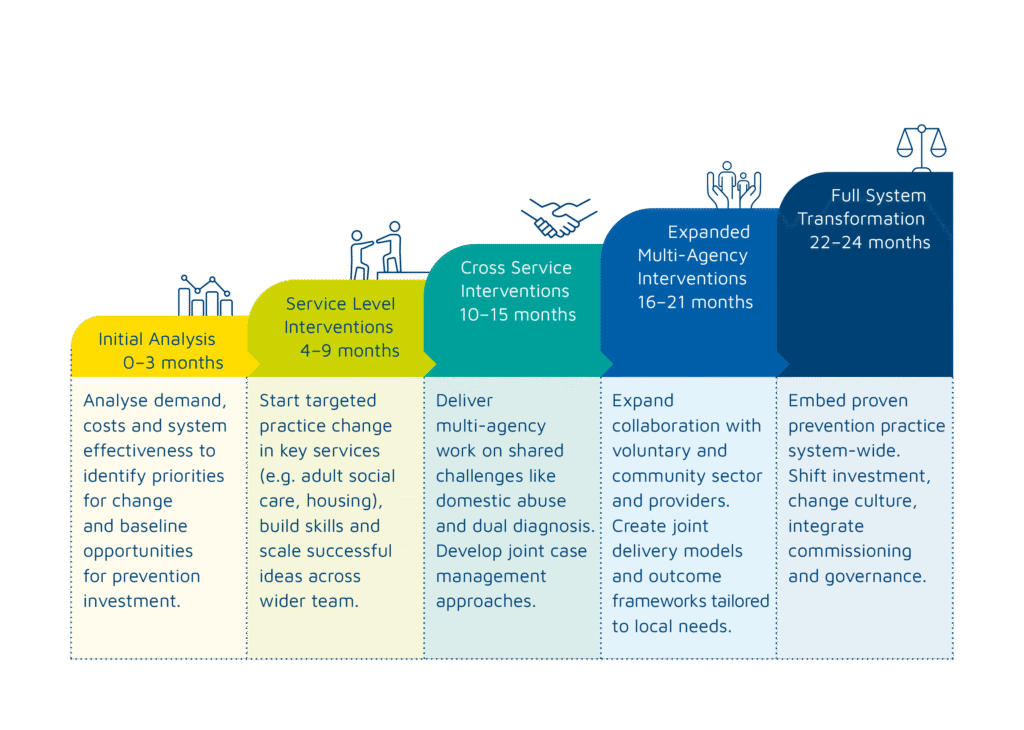
- As councils progress through the stages of IMPOWER’s offer, starting with service-level interventions and building towards full system transformation, they increase their ability to realise a greater share of the achievable impact.
The stages of transforming demand