
Case Studies


A brief proof of concept project in Summer 2025 demonstrated that a strengths-based, proactive approach to discharge could significantly reduce LoS and improve patient experience. This work identified variable ward practices, inconsistent visibility and use of performance data and mixed approaches to escalation.
Building on this NUH, with IMPOWER’s support began work to scale the approach from December 2025 to May 2026. The ambition was to achieve a stronger financial position for the trust through improving outcomes for patients, and empowering frontline staff. The specific target from the work was to reduce the length of stay for geriatric patients by two days.
The programme therefore focused on embedding proactive, data-led behaviours at ward level to reduce LoS, improve timeliness of discharges and create lasting improvements in care delivered.

IMPOWER adopted a test-and-learn, co-design approach, working shoulder-to-shoulder with frontline teams to deliver change in real time. The programme combined on-ward coaching, real-time operational support and structured leadership engagement. Ensuring solutions were practical, evidence-based, co-designed and owned at the ward level.
A key feature of the approach was balancing culture change with the introduction of structured tools and routines.
Rather than introducing a new discharge model, the programme focused on translating established best practice into consistent daily ward behaviours. This meant strengthening discharge planning from admission, improving escalation of barriers, creating greater multidisciplinary ownership of patient flow and supporting clinical and operational teams to make proactive discharge decisions every day.
This included embedding a consistent daily rhythm, introducing ward-level performance dashboards and improving escalation processes to help reduce delays.
Key interventions included:
• Structured action-focused board rounds and afternoon huddles
• Weekend readiness rounds
• Ward-level improvement plans to drive ownership and visibility of changes
• Standardised escalation pathways
• A DISCO community of practice to improve discharge from point of admission
• Optimisation of the Virtual Frailty Ward
• SMT engagement to strengthen leadership and governance
• Ward-level dashboards providing timely performance information to support decision-making
Confidence was built through a highly visible frontline presence, enabling real-time support to unblock barriers and role model behaviours. By building strong relationships with clinical and managerial staff, IMPOWER created trust and encouraged shared ownership of outcomes.
This approach generated confidence across both frontline teams and senior leaders, ensuring the changes implemented were not only effective but aimed to also be sustainable.
The programme focused on translating established best practice principles, including SAFER patient flow and Home First approaches, into consistent daily behaviours and decision-making at ward level.

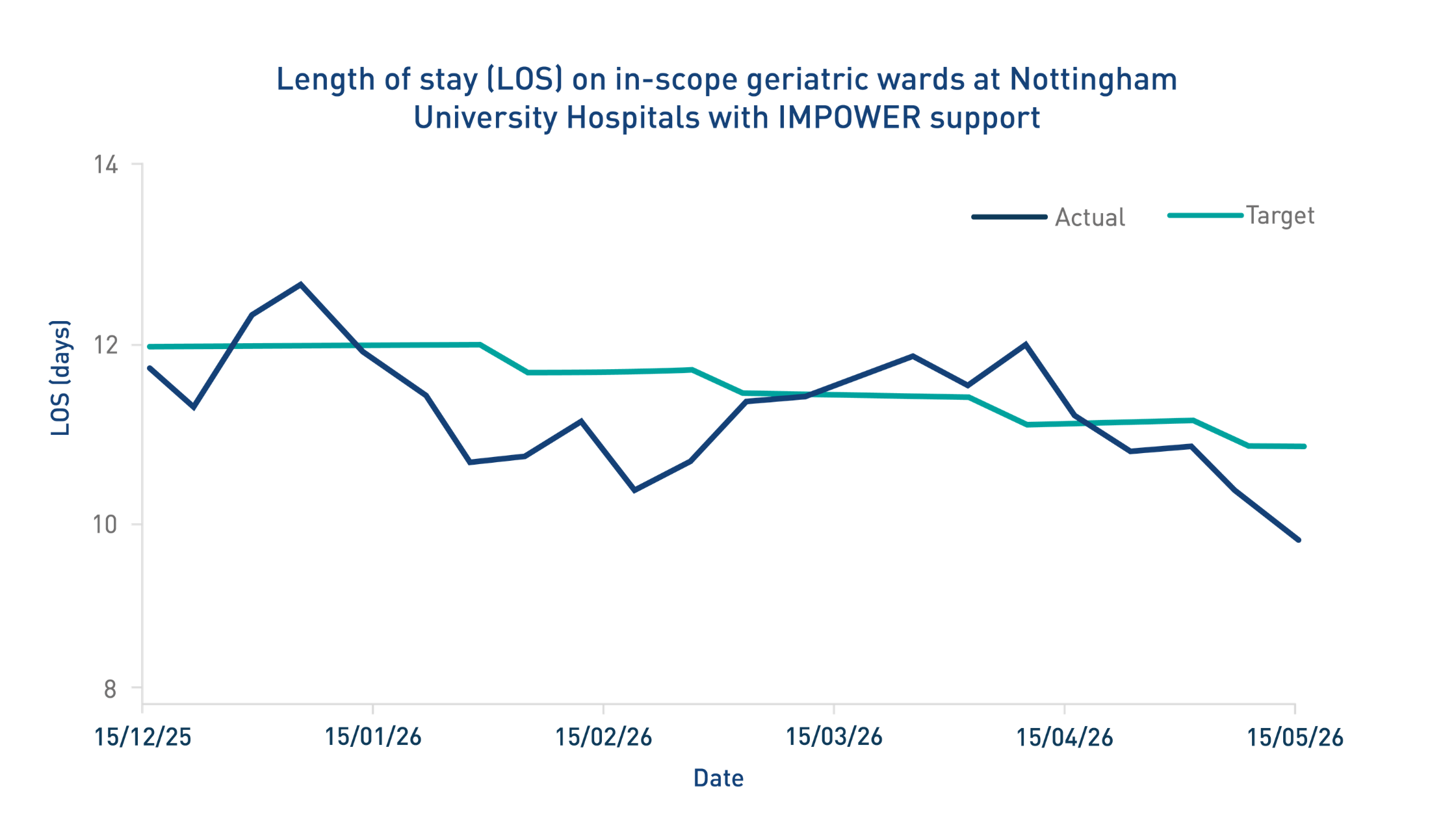
Within the agreed 6-month period NUH with IMPOWER’s support successfully delivered over a two-day reduction in average length of stay across six geriatric wards, achieving the core objective set out in the programme.
Length of stay reduced from 11.4 days in January to 8.7 days in May (23.7% reduction), representing a significant and sustained improvement in patient flow. Maintaining this reduction throughout the full year would enable NUH to save 27,000 bed days.
Beyond the operational benefits, these improvements meant more older people were able to return home sooner, reducing the risks associated with prolonged hospital stays, including deconditioning and loss of independence. Earlier discharge also helped ensure patients received the right support in the most appropriate setting, improving both patient experience and outcomes.
Other benefits include:
- A 24.9% reduction in long length of stay patients (>14 days)- from 49.2% to 24.3%
- Improved discharge performance (April & May total discharges were 645 compared to 590.5- 9.2% increase), including increased weekend activity (April & May weekend discharges were 114 compared to 83.2 baseline- 37% increase)
- Reduced delays through more effective escalation
The work also shifted behaviours across wards, with teams adopting a more proactive approach to discharge, earlier identification of barriers, and stronger multidisciplinary collaboration.
The success of the programme was driven by strong partnership working between NUH’s clinical and managerial teams and IMPOWER, resulting in shared ownership and consistent delivery of improvements.
As a result, NUH is now operating with a more proactive, data-driven approach to patient flow, with sustained improvements in performance and patient experience.
A core aim of the programme was to ensure that improvements were sustainable beyond IMPOWER’s involvement, by embedding capability, tools and behaviours within NUH.
At ward level, teams were supported to take ownership of their improvement journey through ward-specific LoS improvement plans, access to real-time data dashboards and regular leadership forums bringing together consultants and ward managers. These structures now act as the engine for ongoing improvement and accountability.
Capability was built through:
- Coaching teams on their wards in proactive discharge behaviours and decision-making
- Embedding a structured daily rhythm to sustain flow
- Developing a toolkit for wards to assist with improvement within any part of their ward daily rhythm
- Establishing forums such as the DISCO community of practice with practical tools such as discharge checklists and prioritisation frameworks
- Shadowing opportunities to see how the work is delivered by IMPOWER to the trusts own transformation team
At an organisational level, the programme strengthened governance, leadership alignment and performance oversight, including improved meeting structures, clearer roles and responsibilities, and routine use of data in decision-making.
The approach deliberately combined culture change with practical tools – ensuring that new behaviours were supported by systems and routines that enable them to stick.
By the end of the programme, ward teams were increasingly leading improvement activity themselves, using data, structured routines and established escalation processes to identify and address discharge barriers as part of normal day-to-day operational management.
Looking ahead, sustainability will be driven by continued SMT oversight, a local transformation team, routine use of data and ward-led innovation. Embedded governance structures, consistent routines, and strong frontline ownership provide a solid foundation to maintain and further scale the impact across NUH and the wider system.
Work with us
Get in touch if you’d like to discuss the challenges your organisation is facing.