
Case Studies


In February 2025, the UK Government invited all local authorities in two-tier areas – made up of county and district councils along with some small unitary councils – to develop proposals for local government reorganisation (LGR) and submit them by 28 November 2025.
LGR represents a seismic shift in local government across an area accounting for a third of England’s population. For a complex county like Hertfordshire – currently made up of 11 councils serving 1.2 million people across a diverse range of places – it meant finding consensus and producing a coherent and compelling proposal in the space of little more than six months, capable of maximising the scale and pace of benefits for local residents and businesses.
IMPOWER acted as a strategic partner to all 11 organisations to deliver LGR proposals. Alongside shaping a joint programme, drafting the documents and carrying out the necessary technical work, our key role was to act as an honest broker and facilitator to the partnership, helping chief executives to collectively steer past obstacles and resolve potential points of disagreement.
By working at both a leadership and operational level, our consultants were able to build confidence, nurture joint working on the proposals and build the evidence base.
We supported the partnership to articulate a shared ambition focused on communities, place and sustainable services. Through structured engagement with stakeholders and professionals across Hertfordshire, we helped to sharpen focus on the opportunities new unitary arrangements could unlock including: better services, a revitalised relationship with communities, and getting the right balance between scale and localism.
Recognising different views across the partnership on the best delivery model for this shared ambition, we worked with sub-groups to develop and rigorously test three credible structural options for unitary local government in Hertfordshire.

The councils needed confidence that reorganisation could deliver real benefits over the status quo while being operationally achievable.
IMPOWER provided independent analysis and hands-on support to build that confidence.
We developed a shared evidence base, including service-design work, financial modelling, and options appraisal aligned to government criteria. Workshops with service leads translated structural scenarios into operational implications, clarifying how children’s services, adult social care, housing, environmental services and enabling functions could transition safely and coherently.
Crucially, we brought objectivity where views differed, enabling senior stakeholders to test assumptions, understand risks, and build consensus around what was deliverable. This included tackling complex areas such as service disaggregation, reshaping local democracy, financial costs and benefits, and council tax harmonisation, aiming to provide enough clarity and confidence to show that these are solvable problems in practice.

In so many parts of the country, LGR has been characterised by infighting, disagreement and the protection of vested interests that have led to rival proposals being submitted rather than a coherent vision for the future.
In contrast, the process we supported in Hertfordshire was one of the most collaborative. Three credible options have been brought forward based on a single programme and a single evidence base, backed by a shared commitment from all leaders to deliver whatever option is ultimately selected by government.
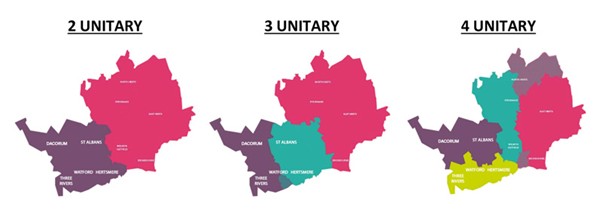
The end result is a comprehensive document outlining the shared ambition and options appraisal and including:
- The financial context for Hertfordshire and the potential impact of LGR
- Plans for empowering communities
- The collaborative process undertaken to consult on proposals
- Plans to mitigate the risks associated with disrupting critical services
- How partners plan to deliver the transition to new unitary authorities
Our belief is that this will position Hertfordshire well in terms of prioritisation by central government, ensuring the benefits of devolution and reorganisation can start to flow for local residents and businesses as quickly as possible.
Our work with the partnership has resulted in a comprehensive and credible set of reorganisation proposals that evidence real potential to improve outcomes and save money.
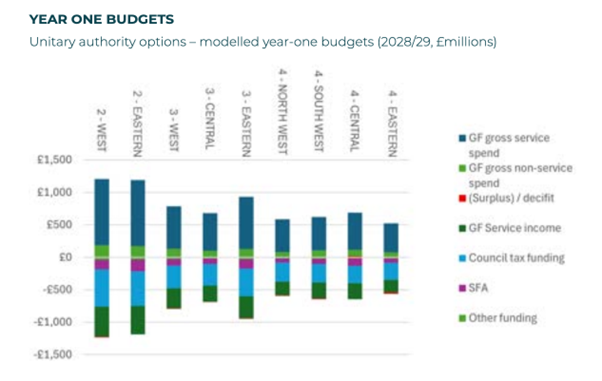
Working closely with chief financial officers from all 11 local authorities, we were able to produce detailed projections on the likely costs and savings associated with each of the three options for year one (below) and across the first five years.
We also modelled performance over the first decade against what would have happened had two-tier local government continued in Hertfordshire (below).
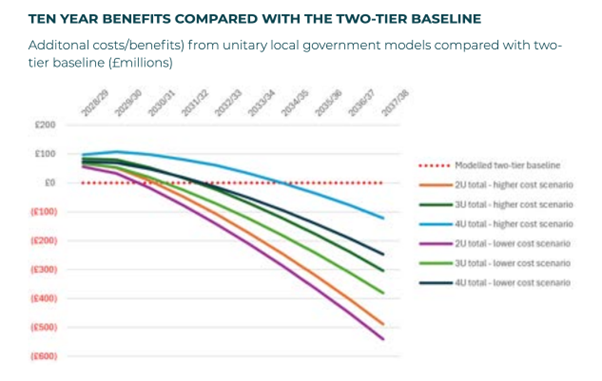
The options, proposing two, three or four new unitary councils, have the potential to deliver savings of up to £418m to the taxpayer over ten years, depending on the model selected by government.
Councils in Hertfordshire now have a well-developed foundation to support further work on transition and implementation, once the direction of travel is set nationally.
Leaders now share a common narrative, a clearer understanding of risks, and a practical view of what structural change would mean for their organisations and workforce.
The work has strengthened collaboration across District and Boroughs and the County Council, laying a template for joint working that will be essential through transition.
Service-level planning has improved organisational readiness by identifying critical dependencies in areas such as systems, workforce, commissioning, governance, property and data; and setting out actions to manage them. By embedding prevention, locality working and evidence-driven decision-making into the design principles, the councils are better placed to navigate both transition and the longer-term pressures facing local government.
Partners also have access to tools and insight that will last beyond the initial project, including ownership of a detailed financial model of costs, benefits and savings.
Our work in Hertfordshire is continuing as we support work to turn the proposals into reality and ensure a smooth transition.
This excerpt from the proposals document sums up the legacy of our support: “Work across Hertfordshire is proceeding at pace beyond these proposals. Councils are working together to engage residents, staff and partners in shaping the future of services, exploring opportunities for prevention and integration and considering what we can do in the interim, alongside planning carefully for the transition to new unitary authorities once our direction of travel is known, following a decision by the Secretary of State. Whatever decision is reached, all councils in Hertfordshire will work together to deliver it.”
IMPOWER delivered in a way that showed they understood the nuance of local government, very quickly getting to grips with the complexity, political context and dynamics across our organisations. They didn’t just provide us with deliverables but enabled us to get where we needed to be.
Chief Executive, Watford Borough Council
IMPOWER was the glue that helped our partnership stick together through what could have been an extremely challenging process. As a result we remain one of the most collaborative LGR propositions in the country carrying significant momentum into delivery – making sure that our residents and businesses are front of the queue to benefit from new, modern councils and devolution.
Chief Executive, St Albans City & District Council
I’m really proud that Hertfordshire managed to work collaboratively thoughout the submission process. With differing views, IMPOWER were an important part of the team, not just crunching the numbers but supporting and nudging chief execs and senior leaders in the right direction. As a neutral adviser they helped to keep us all together, demonstrating skill, resilience and dexterity.
Chief Executive, Hertfordshire County Council
Work with us
Get in touch if you’d like to discuss the challenges your organisation is facing.