
Blogs
How do we shift the dial around integrated neighbourhood care and secondary prevention?
Commitment.
Conviction.
Courage.
Culture.
These are the four words that are needed for any system or provider looking to really drive integrated neighbourhood care. And the four that were focused on by our panel at this week’s NHS Providers Annual Conference when exploring how to bring about outcome-based change for the population and especially the top 5% of health and care users.
The policy direction is clear – left shift from acute to community, from treatment to prevention. The levers to do this from the centre are emerging – new single neighbourhood care contracts, new multi-neighbourhood provider contracts, Advanced Foundation Trusts pipeline, and IHO guidance following on. The models that work – well known and tested. Community urgent response, intermediate care including reablement, Hospital at Home. However, the need to move upstream is not new. So why hasn’t it happened? What is needed to shift the dial this time around?
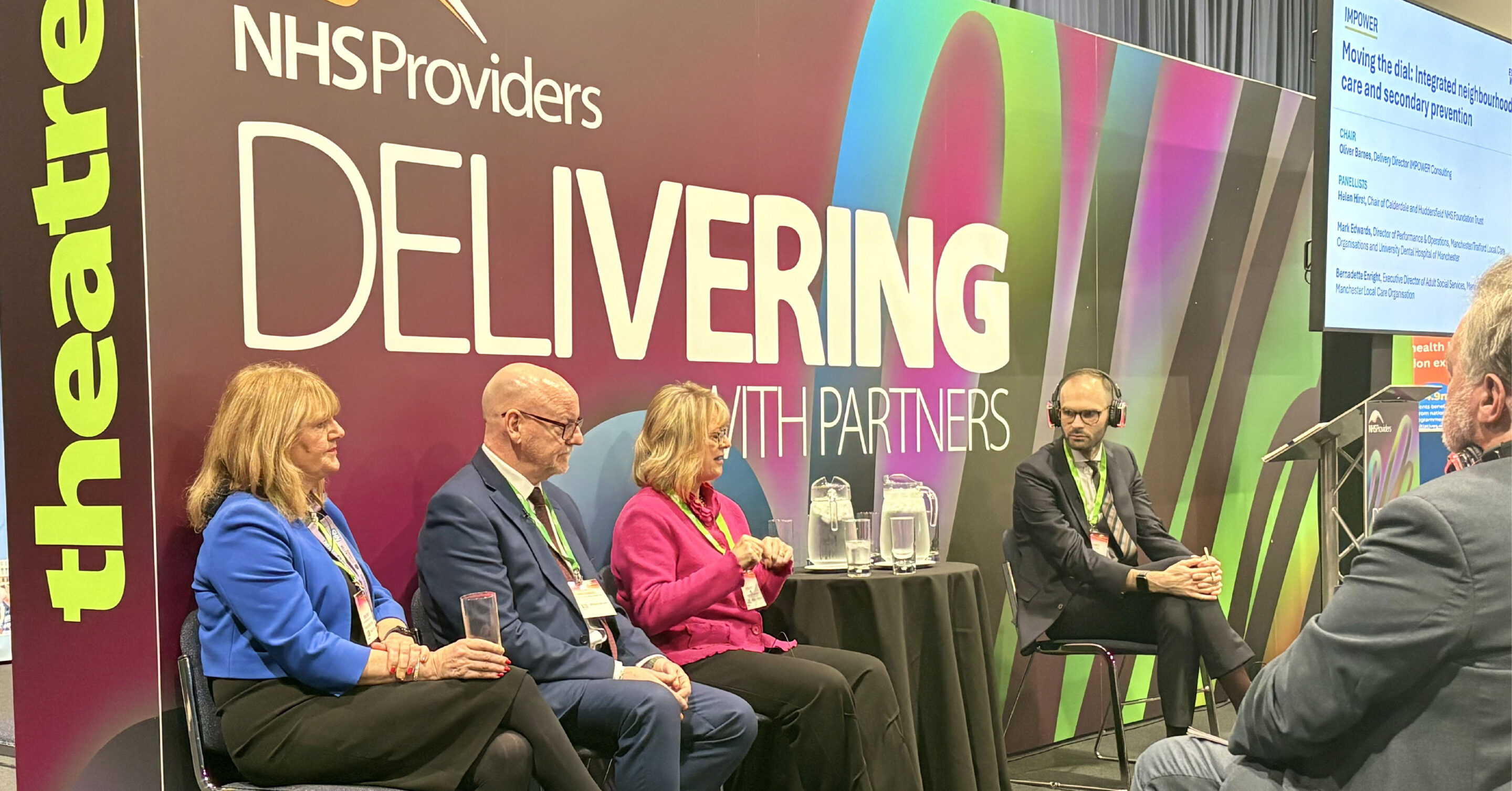
Oliver Barnes, joined by Helen Hirst, Chair of Calderdale and Huddersfield NHS Foundation Trust, Mark Edwards, Director of Performance and Operations at Manchester and Trafford Local Care Organisation (LCO), and Bernie Enright, Executive Director of Adult Social Services at Manchester City Council tackled this head on from their own first-hand experiences in a fascinating session that this blog won’t do full justice to.
So, what are the success factors:
- Commitment: Setting and then working on achieving an inclusive integration ambition is the start. This isn’t just the vision. Nor the agreement on the case for change. All members focused on the need to get into the nitty-gritty. What does this mean for us, our strategy, our teams? What does this mean for our partners? And what does this mean for partnering? Mark and Bernie spoke about the criticality back in 2018 when establishing the LCO to take time on this, and to get into what this actually means for patients and people. Start there, follow through, embed in Medium Term Financial Plan submissions, and constantly check in on collective commitment. Work on the relationships with commitment as a goal in itself. As Bernie commented: “It’s our duty to collaborate.”
- Conviction: While collective ambition is the foundation, belief is the thread needed for delivery. Belief that this is right for the population, for patients when they need care, individuals who draw on social services when they are home. Build this belief by using data and insight, drive it through collective leadership. As Helen commented, “be very clear as to what ‘left shift’ means” – understand where you are starting, what you are shifting, and why.
- Courage: With all the operational pressures across the NHS now, the headspace to do ‘big change’ is low. Hope is low, fatigue is high. Courage is needed. The panel’s advice? Start small, test, learn, broadcast. This was highlighted with their experience of early neighbourhood models and community rapid response. Calling an entire system to action is nearly impossible – getting the system to want to go into action by showing results in a part of it, that’s the key.
- Culture: ‘Culture eats strategy for breakfast’ – and nowhere is this truer than in integration. Focus on empowering and enabling frontline teams. Build the spaces needed for relational growth and invest in this. As Mark put it, “you know you’ll have succeeded when the stories start coming back to you” – when sharing an example of a social worker finally being allowed into a home after the district nurse reassured the individual they can be trusted and it’s the best thing for them. Culture is at the heart of delivery – as Helen said, “the goal is to get all to serve the population, not just patients.”
So, against these four ‘C’s’ where are you?
- On commitment, have you set your ambition, is it shared with all true partners?
- On conviction, are you crystal clear on what difference to outcomes your neighbourhoods will have?
- On courage, have you identified where you will test and build the conditions for success?
- On culture, are you working on changing behaviours and investing in behaviour change?
Our report with the Academy of Medical Royal Colleges explored why the country has not yet delivered the long-promised shift to more home and community-based care. At IMPOWER, we’re experts at setting the ambition and delivering across the health and care interface. Experts at making integration real, and at getting the outcomes needed. For the last five years we have worked on our approach to delivering this – Valuing Home. At its heart we support culture and behaviour change, and we do this after working with you on setting your ambition. From this we then work with you to build new models of care for the future, enable frontline teams to work as they need to, and bring system leaders assurance on the financial, capacity and flow benefits that come from delivery. Our impact is clear – proven bed day savings, for example in our work in Manchester.
To find out how we can support you and, in particular how we can reduce your acute bed days right now, please get in touch.